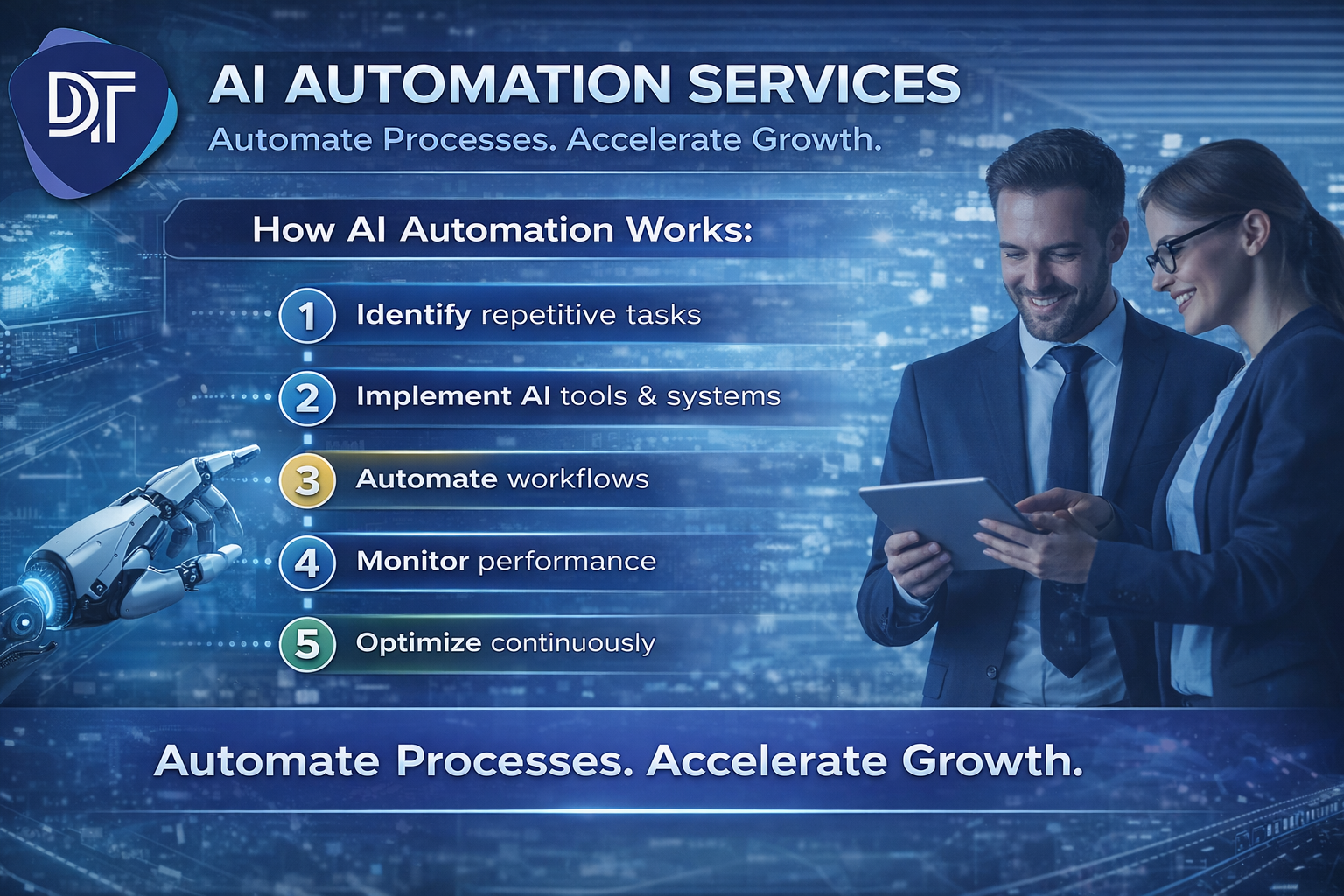
What Are AI Automation Services?
AI Automation Services refer to the use of artificial intelligence technologies to automate business processes, analyze data, and perform tasks with minimal human intervention.
Unlike traditional automation, AI-powered systems can:
• Learn from data
• Make decisions
• Adapt to changing conditions
These services include workflow automation, AI chatbots, data processing, and intelligent decision systems that improve overall business performance.
Real-World Applications Across Industries
Businesses today are using AI Automation Services in practical and measurable ways.
1. Customer Support Automation
AI systems now handle up to 70–90% of routine customer queries, allowing human agents to focus on complex issues.
2. Marketing & Lead Management
Companies automate lead generation, email responses, and campaign management using AI-driven tools, improving response time and conversion rates.
3. Finance & Operations
AI automates invoice processing, fraud detection, and financial reporting, reducing errors and saving time.
4. Ecommerce & Logistics
Retailers use AI to manage inventory, track orders, and send automated alerts, improving operational efficiency.
Latest Industry Trends in AI Automation
The evolution of AI Automation Services in 2026 is driven by new technologies and business needs.
AI Agents as Digital Workers
AI agents can now perform multi-step tasks, coordinate workflows, and act like digital employees within organizations.
Shift to End-to-End Automation
Businesses are moving from automating single tasks to automating entire workflows, improving efficiency at scale.
Real-Time Decision Systems
Modern AI tools provide instant insights and automate decision-making processes instead of relying on static reports.
Integration with Existing Tools
AI connects CRMs, emails, and business systems, reducing manual work and improving data flow across platforms.
Real Business Impact and User Experience
Companies implementing AI Automation Services are seeing real benefits in daily operations. For example, businesses using AI for proposal generation and reporting have reduced preparation time significantly while maintaining quality.
In real-world scenarios, teams report:
• Faster task completion
• Better collaboration
• Reduced manual errors
• Improved customer satisfaction
However, industry news also highlights challenges. Some companies are still struggling to achieve ROI from AI investments, emphasizing the need for proper strategy and implementation.
Practical Tips for Implementing AI Automation
To get the best results from AI Automation Services, businesses should follow a strategic approach:
• Start with repetitive and high-impact tasks
• Integrate AI with existing systems
• Monitor performance continuously
• Combine AI with human oversight
• Scale automation gradually
Experts recommend focusing on real business problems rather than adopting AI just for trends.
The Future of AI Automation Services
The future of AI Automation Services is focused on intelligent, scalable, and autonomous systems. Technologies like multi-agent AI systems and real-time automation platforms are expected to become standard in business operations.
As AI continues to evolve, companies that invest in AI Automation Services today will be better positioned to improve efficiency, reduce costs, and stay competitive in the digital economy.
Conclusion
AI Automation Services are no longer optional—they are essential for businesses aiming to grow in a competitive market. From automating daily tasks to enabling smarter decision-making, these services provide real value across industries.
By adopting the right AI Automation Services, businesses can streamline operations, enhance productivity, and achieve long-term success in an increasingly automated world.