What is AI Workflow Automation?
AI WORKFLOW AUTOMATION refers to using artificial intelligence to automate business processes, analyze data, and make decisions with minimal human involvement. Unlike traditional automation, AI systems can understand context, learn from data, and improve over time.
This makes workflows more flexible, accurate, and scalable across departments like HR, finance, IT, and marketing.
How AI Workflow Automation Works
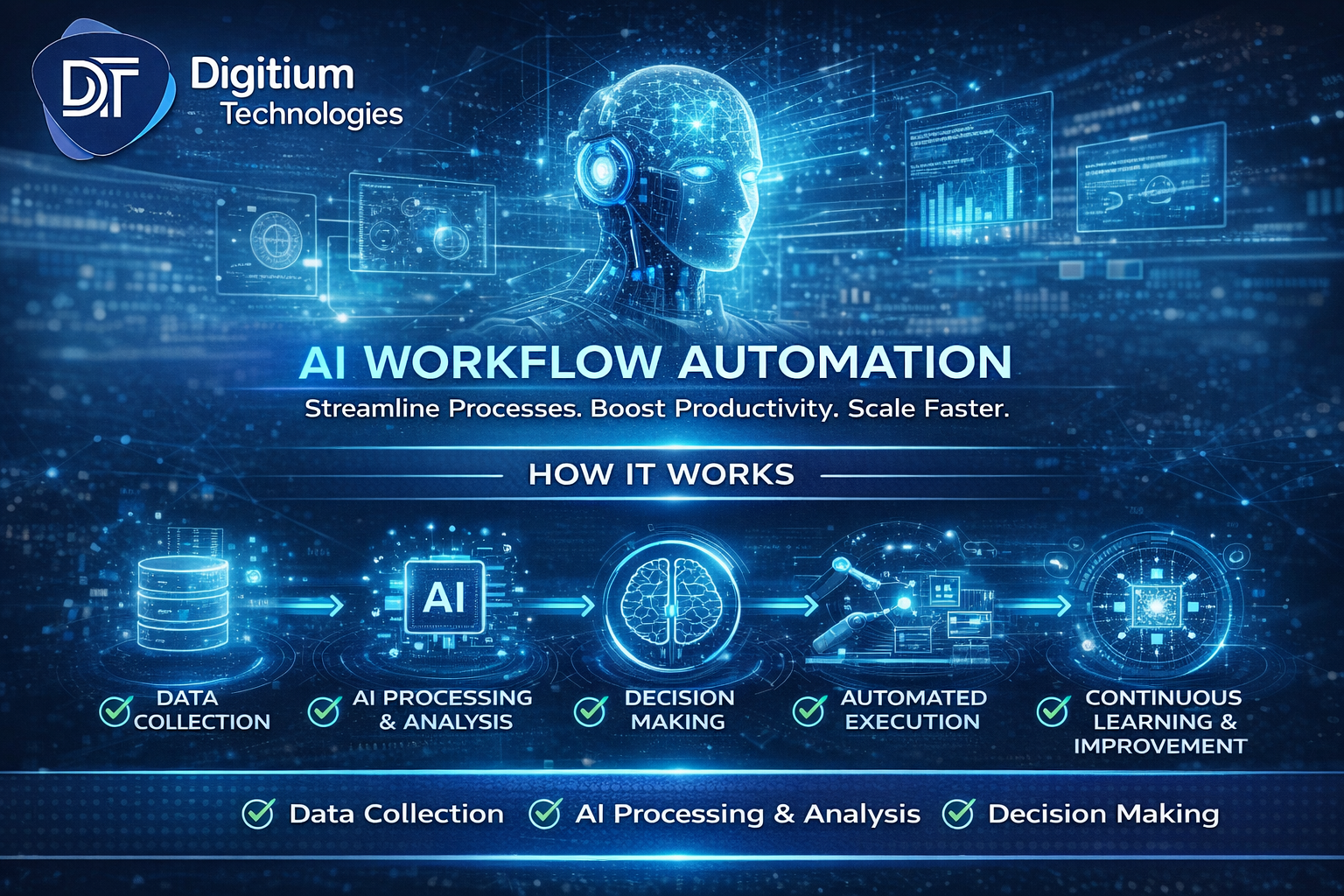
The process of AI WORKFLOW AUTOMATION follows a structured approach:
• Data Collection: Gathering data from multiple systems
• AI Processing & Analysis: Using machine learning to analyze patterns
• Decision Making: AI suggests or takes actions based on insights
• Automated Execution: Tasks are completed without manual input
• Continuous Learning: Systems improve using feedback and outcomes
This cycle enables businesses to move from reactive to proactive operations.
Real Industry Use Cases
Many companies are already benefiting from AI WORKFLOW AUTOMATION in real-world scenarios:
• Customer Support: Chatbots handle up to 80% of queries efficiently
• HR Automation: AI screens resumes and schedules interviews
• Finance: Automated invoice processing and fraud detection
• IT Operations: Automated ticket resolution and system monitoring
Leading platforms like ServiceNow and UiPath are helping organizations integrate AI into daily workflows.
Key Benefits for Businesses
Implementing AI WORKFLOW AUTOMATION provides measurable advantages:
• Improved Efficiency: Reduces repetitive tasks
• Better Decision Making: Uses real-time data insights
• Cost Savings: Minimizes manual labor and errors
• Scalability: Easily handles growing workloads
• Enhanced Productivity: Teams focus on high-value work
According to industry insights, businesses using AI automation report significant productivity gains and faster resolution times.
Industries Leading the Adoption
Several industries are rapidly adopting AI WORKFLOW AUTOMATION:
• Healthcare: Patient data management and diagnostics
• Finance: Risk analysis and compliance automation
• Manufacturing: Predictive maintenance and operations
• Logistics: Supply chain optimization
• Legal: Document processing and contract analysis
These sectors benefit due to their complex and data-heavy workflows.
Future of AI Workflow Automation
The future of AI WORKFLOW AUTOMATION is moving toward fully autonomous systems. Recent trends show that businesses are integrating AI agents that act like digital employees, handling tasks independently and improving productivity.
Experts predict that by 2026, nearly half of enterprise applications will include AI-powered automation features, making it a core part of business strategy.
Conclusion
AI WORKFLOW AUTOMATION is no longer just a trend—it is becoming essential for modern businesses. By automating processes, improving accuracy, and enabling smarter decisions, it helps organizations stay competitive in a digital-first world. As technology evolves, companies that adopt AI-driven workflows early will be better positioned for long-term growth and success.